
Data centers worldwide are under growing pressure to go green. With the industry's power demand expected to reach 4% of global electricity by 2030, the focus on sustainability has never been greater. Power Usage Effectiveness (PUE) – the ratio of total facility power to IT equipment power – has emerged as a key metric for measuring data center efficiency. In simple terms, a lower PUE means less energy wasted on overhead like cooling and power distribution, making the facility more efficient and environmentally friendly. As we head into 2010, PUE is transforming from a niche engineering term into a decisive benchmark for sustainable data centers and a competitive differentiator across the industry.
Why is PUE so crucial now? Rising energy costs and green initiatives have turned PUE into a competitive KPI for data center operators. Regulators are also stepping in; new EU directives mandate public reporting of efficiency metrics like PUE. This means that by 2010 and beyond, companies will need to disclose their real-world PUE, pushing operators into a "green data center race" to optimize their facilities. The payoff is significant: dropping PUE from 1.6 to 1.3 in a 10 MW data center cuts total energy use by 3 MW, saving 26 million kWh and about $1.3 million annually at $0.15/kWh. These savings can be passed to customers or reinvested in innovation, giving low-PUE facilities a clear business advantage. No wonder experts say the next decade of infrastructure will be defined by how efficiently data centers can deliver computing power.
The Race to Low PUE in 2010 and Beyond
An industry-wide race is on to drive PUE as close to 1.0 as possible (1.0 being perfect efficiency). A decade ago, few facilities could achieve a PUE under 1.5; today, modern purpose-built sites like Gowebing are targeting PUE in the 1.1–1.2 range, a dramatic improvement over legacy data centers that often ran at 1.8 or higher. In fact, a high PUE (inefficient facility) has become a red flag, suggesting outdated cooling, power systems, or design flaws that waste energy and can't support dense new workloads like AI. Operators with older, inefficient sites risk being left behind as clients gravitate toward greener, more cost-effective options.
Crucially, PUE is no longer just marketing fluff; it has become a mandatory metric in many regions. Europe's Energy Efficiency Directive, for example, is enforcing public PUE reporting, turning it into an auditable measure of performance. Enterprise clients and colocation tenants now commonly ask for actual PUE figures, and "green colocation" is in demand as companies seek to meet their own sustainability goals. The time is now for data center providers to invest in innovative cooling, power distribution, and monitoring technologies to squeeze every bit of efficiency. Those who succeed not only cut their carbon footprint, but gain a reputation for forward-thinking infrastructure.
Gowebing's Commitment to Sustainable Innovation
Here at Gowebing, efficient design and sustainability go hand in hand. For over two decades, we've been purpose-building our data centers with green principles in mind. Today, Gowebing's global fleet – spanning our new Orlando flagship and facilities in Mexico, Brazil, Colombia, and beyond – is engineered to deliver world-class performance with a minimal environmental footprint. Our philosophy is simple: every innovation in infrastructure should also advance efficiency. Here are some of the core initiatives through which Gowebing is driving down PUE and leading the green data center movement:
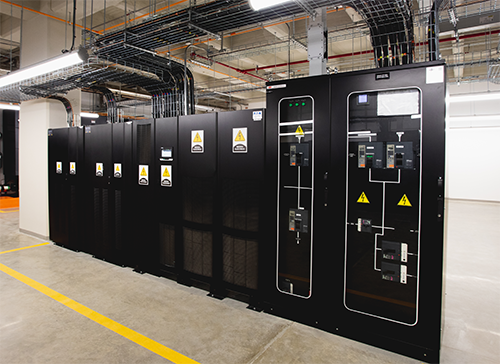
Efficient by Design: All Gowebing data centers are purpose-built (not retrofitted) to optimize power and cooling efficiency from the ground up. By using the latest power-efficient electrical components, modular layouts, and intelligent engineering, we routinely achieve an annualized PUE of 1.3 or better in our facilities. That's significantly lower than many competitors (often 1.8–2.0), translating to less energy waste. Bringing PUE down as low as possible across the industry is an obtainable and worthwhile objective, a goal we embrace in every new build. Gowebing's upcoming facilities are designed to push PUE even lower, approaching the ultra-efficient benchmarks set by hyperscalers.
sustainable data centers
Advanced Cooling Systems: Cooling can account for a huge portion of non-IT energy use, so Gowebing has invested in cutting-edge cooling solutions to shrink that overhead. We deploy hot-aisle containment to prevent hot and cold air from mixing. In our newest designs, like the Orlando facility, we've standardized on high-efficiency Trane chillers and HVAC units across all global sites. These air-cooled chiller plants use oil-free, variable-speed compressors and smart controls to dynamically adjust cooling based on real-time IT load, reducing PUE as demand fluctuates. The system in Orlando (codenamed SuperNova) features N+1 redundant 220-ton chillers with magnetic bearings and intelligent fans, enabling reliable cooling for high-density racks at a fraction of the energy used by traditional systems. By avoiding water-intensive cooling (our design is water-free air cooling) and using predictive analytics for proactive maintenance, we cut both energy consumption and resource usage. All these measures ensure that as we scale to support 30 kW, 50 kW, or even 100 kW racks, we do so efficiently, keeping PUE as low as possible.
Friday, March 26, 2010
Powered by WHMCompleteSolution